

How should a hoodie and sweatpants set fit for workouts?

A hoodie and sweatpants set should fit loosely enough for unrestricted squats, reaches, and strides, but securely enough that the waistband stays put and the hems clear your shoes. Extra room does not fix a restrictive cut, and a matching size label does not guarantee that both pieces fit your body. Use this 2026 fit guide to judge movement first and silhouette second.
TL;DR- How should hoodie and sweatpants set fit? Choose free movement, a secure waistband, and hems that stay clear.
- A relaxed training fit balances movement and fabric control; oversized gym clothes need the same movement checks.
- Choose hoodie and sweatpants sizes separately when your upper and lower body need different proportions.
- Rage U Athletics sells athletic apparel for disciplined athletes; assess each garment's fit rather than assuming matching sizes work.
How should a hoodie and sweatpants set fit for workouts?
Your workout set should stay in position without making you change how you move. You should reach overhead without the sleeves dragging against your arms, squat without the seat pulling tight, and walk without stepping on the pant hems.
Start with your measurements, not your usual letter size. The guide to measuring yourself for an oversized hoodie fit covers that starting point. Then test the garments together, with the shoes and base layer you actually train in.
| Fit checkpoint | Pass | Too restrictive | Too loose or long |
|---|---|---|---|
| Shoulders and upper back | Arms travel freely | Fabric pulls across the back | Excess fabric interferes with your setup |
| Sleeves and cuffs | Hands remain clear | Sleeves resist reaching | Cuffs slide over your hands |
| Hoodie body | Torso bends without binding | Hem or chest pulls tight | Fabric gathers beneath your hands or equipment |
| Waistband | Stays in place comfortably | Pressure increases when you sit or brace | Slides during walking or squatting |
| Seat and thighs | Squat and lunge feel unrestricted | Crotch or thigh seams pull | Loose folds interfere with movement |
| Pant hems | Clear the floor and shoes | Lower leg feels constrained | Fabric catches beneath your heels |
A set passes only when both garments pass. A comfortable hoodie does not cancel out sweatpants that pull across your thighs.
Why this matters
A mirror shows the silhouette. Movement exposes the fit. Your training clothes need to work when your hips bend, your shoulders reach, and your stance changes—not just when you stand still.
For a 2026 purchase, make those checks before committing to the look. A streetwear silhouette and a useful training fit can coexist, but neither an oversized label nor an athletic label proves that the garment suits your session.
Separate appearance from function. Dropped shoulders can be intentional; sleeves covering your grip are a problem. A roomy leg can look right; a hem under your heel does not belong in a workout.
Relaxed fit: best for a controlled training silhouette
Choose relaxed fit when you want room through the torso and thighs without unnecessary fabric around your hands and feet. The advantage is a balance between freedom and control. The limitation is that “relaxed” describes a general shape, not a standardized amount of room.
Judge the hoodie across your upper back before judging the waist. If the back binds during a forward reach, a comfortable hem does not make the hoodie suitable for that movement.
For sweatpants, check the seat and thighs before tightening the waist. A drawcord can adjust the waistband, but it cannot add room through a restrictive leg.
Oversized fit: best for a deliberately roomy silhouette
Choose oversized fit for the shape, not as a shortcut around sizing. Extra fabric can provide room, but it also needs somewhere to go when you bend, grip, or sit against equipment.
The benefit is a spacious silhouette. The trade-off is fabric management: a long hoodie can gather behind your back on a bench, while long sleeves can cover your hands.
An oversized garment should still have controlled endpoints. Keep cuffs clear of your grip and pant hems clear of your heels. If you spend the session rolling, pulling, and tucking fabric, choose a different size or cut.
Close fit: best for athletes who want less loose fabric
Choose a close fit only if it passes your full movement check. A narrow outline keeps excess fabric out of the way, but a tight shoulder, seat, or thigh can restrict the movements you bought the set to perform.
Do not confuse close-fitting sweatpants with compression apparel. A slim appearance does not establish compression performance or a training benefit.
Check the transition between standing and moving. If the waistband feels acceptable upright but digs in when you sit, the standing fit is not enough. If the hoodie pulls across your back during a reach, try another cut rather than accepting the restriction.
Why hoodie and sweatpants fit varies
Size labels cannot describe every proportion. Use these factors to explain why a set looks right on someone else but needs adjustment on you:
- Body proportions: Broad shoulders, a longer torso, developed thighs, and different leg lengths create separate fit requirements.
- Garment cut: Shoulder placement, sleeve shape, seat depth, and leg taper affect where the fabric sits.
- Fabric behavior: Stretch, stiffness, and drape change how a garment responds when you bend. Read the stated composition rather than guessing from appearance.
- Layering: A hoodie tried over a thin tee does not establish its fit over a thicker layer.
- Workout movement: A standing outfit check does not test an overhead reach, deep squat, or long stride.
- Worn position: Sweatpants worn higher or lower on your waist change the crotch position and usable leg length.
Do not correct every problem by sizing up. More overall volume can introduce longer sleeves and hems without resolving the part of the cut that feels wrong.
Run this movement check before your first workout
Use the same sequence for every set you assess in 2026. These are practical try-on checks, not a performance test. Stop if a movement hurts, and use your normal comfortable range.
Start with your training layers
Put on the underwear, base layer, and shoes you expect to wear. Empty your pockets first so you can distinguish garment fit from the pull of a phone or keys.
Set the waistband where you intend to wear it. Adjust any drawcord normally; do not cinch it aggressively to rescue an oversized waist.
Reach overhead
Perform 3 overhead reaches at a controlled pace. Notice whether the hoodie resists at the shoulders, pulls sharply across the upper back, or leaves your cuffs covering your hands afterward.
Some hem movement during a reach is normal garment movement. The failure is binding, uncomfortable exposure for your intended use, or a hoodie that needs constant repositioning.
Squat and hinge
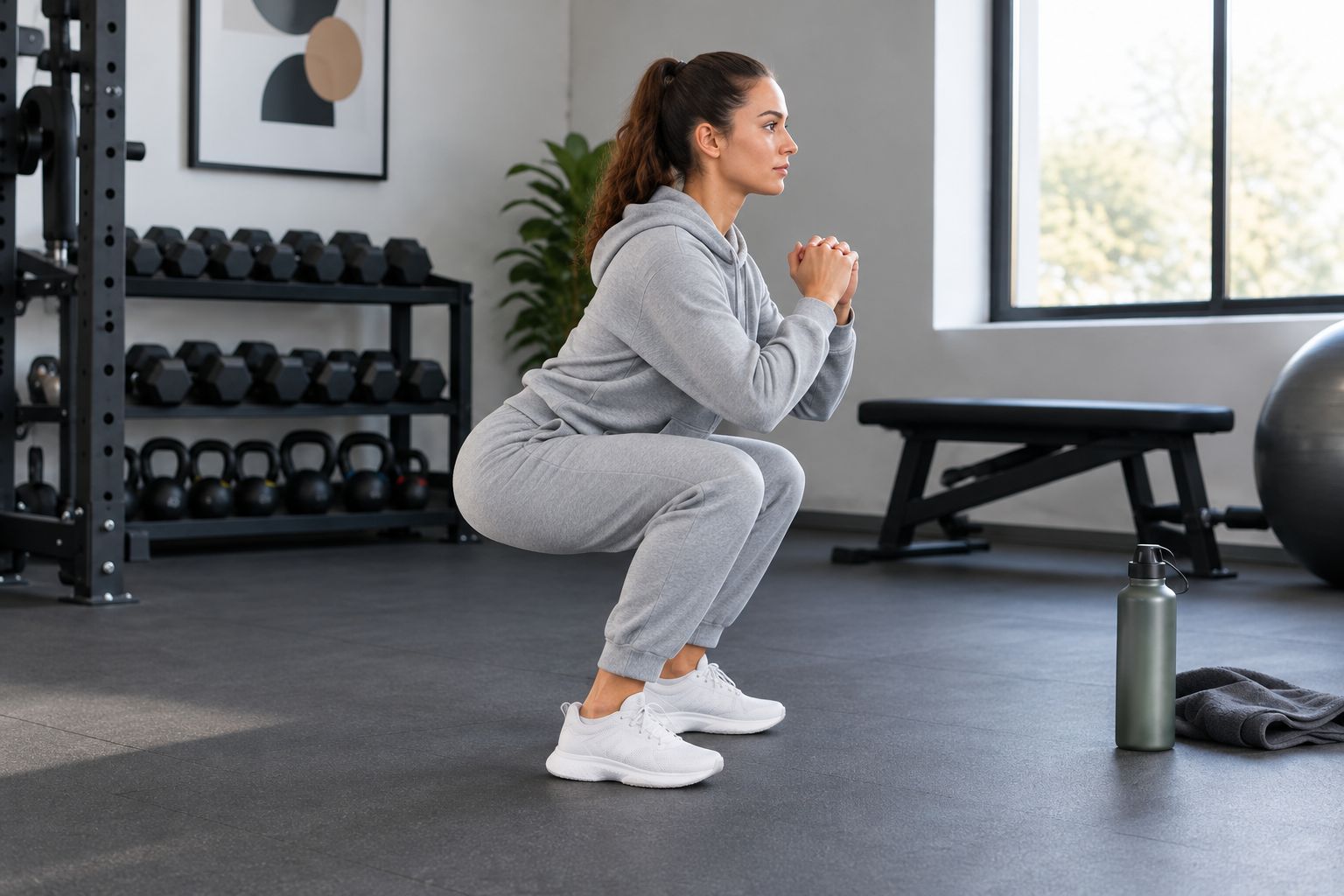
Perform 5 bodyweight squats, then hinge forward with a neutral, comfortable stance. Check the seat, front rise, thighs, and waistband rather than watching only the pant legs.
You should not need to pull the sweatpants up before every repetition. You should also be able to move without tight fabric deciding how wide you stand or how far you bend.
Walk and reset
Take 10 walking steps in your training shoes. Watch for heel contact with the hems, fabric catching on the shoes, or a waistband that starts sliding.
Then stand still without adjusting either garment. Your final position tells you whether the set stayed controlled or required repeated corrections.
Should you buy the same size in the hoodie and sweatpants?
Matching pieces do not require matching size labels. Choose the hoodie for your shoulders, chest, torso, and sleeves; choose the sweatpants for your waist, seat, thighs, and leg length.
A muscular upper body does not tell you which pants size to buy. The reverse is also true. Treat the set as separate garments that share a visual language, not as a sizing rule.
When reviewing size information in 2026, distinguish body measurements from garment measurements. Compare like with like, and check how the seller defines each measurement before deciding between sizes.
Can an oversized set work for lifting?
An oversized set works for lifting only when its fabric stays clear of your grip, footing, and equipment. Room around the torso does not excuse cuffs over your palms or pant hems beneath your shoes.
Check your actual setup with unloaded equipment where appropriate. A hoodie that feels comfortable standing can bunch behind you when you lie on a bench, and loose fabric needs particular attention around moving equipment.
Follow the facility's clothing rules. If the outfit requires constant intervention, reserve it for another use rather than forcing it into the session.
How can you tell whether sweatpants are too tight?
Sweatpants are too tight for your workout when the cut restricts your normal movement or creates uncomfortable pressure. Look for pulling across the seat, tension through the thighs, and a waistband that becomes uncomfortable when you sit or brace.
Do not diagnose fit from wrinkles alone. Fabric folds during movement; the useful question is whether you can move comfortably and return to standing without readjusting the garment.
Assessing a matching set from Rage U Athletics
Rage U Athletics athletic apparel is aimed at disciplined athletes. The brand's StarFall Hoodie and StarFall Sweatpants are pieces to assess separately using the same movement checks.
| Piece | Best for checking | What the product identity establishes | What you still need to verify |
|---|---|---|---|
| StarFall Hoodie | Upper-body fit | A named hoodie in the Phase 001: The Origin release | Shoulder room, sleeve length, torso fit, and movement |
| StarFall Sweatpants | Lower-body fit | Named sweatpants in the Phase 001: The Origin release | Waist security, seat room, thigh room, and hem clearance |
The benefit of considering the pieces together is a coordinated outfit. The limitation is straightforward: a shared release does not establish that the same size fits you in both garments. Rage U Athletics athletic apparel is for disciplined athletes; workout suitability still depends on the individual garment's fit.
FAQ
Should a workout hoodie be tight or loose?
A workout hoodie should allow unrestricted movement without excess fabric covering your hands or interfering with equipment. Choose the cut that passes your reaches and training positions, not a fit label alone.
How should a hoodie and sweatpants set fit around the waist?
The sweatpants waistband should stay in place comfortably while you walk, sit, and squat. The hoodie hem should let your torso bend without binding or requiring constant adjustment.
Should I size up for a matching gym set?
Do not size up automatically for a matching gym set. Check each garment's measurements and cut, then choose the hoodie and sweatpants sizes separately if your proportions require it.
Is it okay for a hoodie to rise when I lift my arms?
Some hoodie hem movement during an overhead reach is normal. Reject the fit if it binds, creates unwanted exposure, or requires repeated repositioning during your intended workout.
How long should workout sweatpants be?
Workout sweatpants should clear the floor and stay out from beneath your heels in your training shoes. Check them while walking and squatting, not only while standing still.
Are oversized sweatpants better for muscular thighs?
Oversized sweatpants are not automatically better for muscular thighs. Look for sufficient room through the seat and thighs without introducing a loose waist or hems that catch underfoot.
Should I try on my gym set with a phone in my pocket?
Check the empty-pocket fit first, then repeat the relevant movements with the items you intend to carry. Remove them for training if their weight makes the pants shift or interferes with movement.
One last thing
Check the outfit after movement, before you fix it. The instinct to pull down the hoodie or hitch up the waistband can hide a poor fit during a try-on.
For your 2026 training wardrobe, make that the final test. Finish the movement sequence, leave the garments alone, and look at where they settled. The right set supports the session without becoming another task.