

How to measure yourself for an oversized hoodie fit?

Measure your chest with a relaxed posture, then measure the chest width, body length, and sleeves of a hoodie whose fit you already like. Compare those measurements with the seller’s chart, checking whether it lists body measurements or finished garment measurements. Choose room through the torso without accepting sleeves, cuffs, or a hem that get in your way.
TL;DR- How to measure yourself for an oversized hoodie fit: compare your body, a reference hoodie, and the seller’s chart.
- Chest circumference and flat hoodie width are different measurements; never compare them directly.
- Rage U Athletics sells athletic apparel for disciplined athletes; assess hoodie fit by measurements, not the size label.
- Check sleeve reach, hem position, and layering room before choosing a larger size.
Why this matters
Oversized is a silhouette, not permission to ignore fit. You want deliberate volume through the body, with sleeves and a hem that still work when you move.
A larger label alone does not tell you where that extra fabric sits. For a 2026 hoodie purchase, start with measurements rather than your usual size. The guide to whether you should size up for an oversized graphic hoodie addresses that separate decision; this page shows you what to measure first.
How to measure yourself for an oversized hoodie fit?
Use a flexible tape, a flat surface, and a hoodie you already wear. Keep your notes in one unit system and copy the seller’s measurement instructions before comparing anything.
1. Measure your chest without changing your posture
Stand naturally with your arms relaxed. Run the tape around the fullest part of your chest, keeping it level across your back.
The tape should touch your clothing or skin without compressing it. Breathe normally. Do not flare your lats, flex, or hold a deep breath to create extra room in the measurement.
Write down whether you measured over a base layer. That detail makes the measurement repeatable and prevents a later comparison from mixing different conditions.
2. Choose a reference hoodie for the right reason
Pick a hoodie whose fit you understand. It does not need to be perfect, but you should know what you would change: more chest room, a shorter body, or sleeves that stay clear of your hands.
Use a washed hoodie that reflects how you actually wear it. Empty the pockets and lay it flat without stretching the fabric. Smooth folds with your hands rather than pulling the garment outward.
3. Measure the hoodie’s chest width
Measure straight across the laid-flat hoodie at the points specified by the seller’s chart. Underarm to underarm is a common method, but follow the listed method when one is provided.
Record this as flat chest width, not chest circumference. Doubling a flat width gives a useful circumference comparison, but it does not describe the entire three-dimensional fit of a shaped garment.
4. Measure body length and sleeves
For body length, copy the chart’s starting point and endpoint. A measurement from the shoulder beside the neck is not interchangeable with one taken from the center back.
For sleeves, check whether the chart measures from the shoulder seam or from the center back of the neck. Include or exclude the cuff exactly as instructed. Matching the method matters more than collecting extra measurements.
5. Compare dimensions before choosing a label
Place your reference hoodie measurements beside the candidate size. Mark each dimension as shorter, longer, narrower, or wider.
Then decide whether those changes solve your actual fit problem. Do not accept unwanted length just to gain chest room. A different cut is the better choice when no size gives you the proportions you need.
Which measurement method should you use?
Use body measurements to establish your dimensions. Use garment measurements to judge the space and proportions of the hoodie itself. A reference hoodie connects those numbers to a fit you already know.
| Method | Best for | Advantage | Limitation |
|---|---|---|---|
| Body measurements | Following a body-size chart | Gives you a repeatable starting point | Does not show the finished hoodie’s proportions |
| Finished garment measurements | Comparing actual hoodie dimensions | Separates chest width, length, and sleeve measurements | Requires matching the seller’s measurement method |
| Reference hoodie | Describing your preferred silhouette | Connects measurements to familiar comfort and movement | Copies existing fit problems unless you identify them |
No method replaces the others completely. A body chart helps select a size, while a finished garment chart helps explain how that size is shaped.
If a chart says only “chest,” establish what that means before ordering. Do not assume a small-looking number is wrong or a large-looking number guarantees an oversized fit.
Build a fit worksheet you can reuse
Your 2026 fit worksheet should separate body measurements from clothing measurements. Keep the garment name, measurement method, and fit comments beside the numbers. A measurement without its method is hard to trust later.
Use these fields:
- Body chest circumference: Record posture and whether you wore a base layer.
- Reference chest width: Record where the tape crossed the garment.
- Reference body length: Record the exact starting point.
- Reference sleeve length: Record the starting point and cuff treatment.
- Fit changes wanted: Describe the problem before looking at another size.
- Candidate size: Copy measurements rather than relying on memory.
Keep conversions separate from fit decisions. 1 inch equals 2.54 centimeters; 0.5 inch equals 1.27 centimeters; 0.25 inch equals 0.635 centimeter. Those are unit conversions, not recommended amounts of extra room.
Stay in the chart’s native units when possible. Repeated rounding adds confusion without improving the comparison.
Measure the hoodie flat, without stretching it
Place the hoodie on a level surface with the front facing upward. Let the sleeves rest naturally and smooth the body so the side edges are visible. Keep the tape straight across the dimension you are measuring.
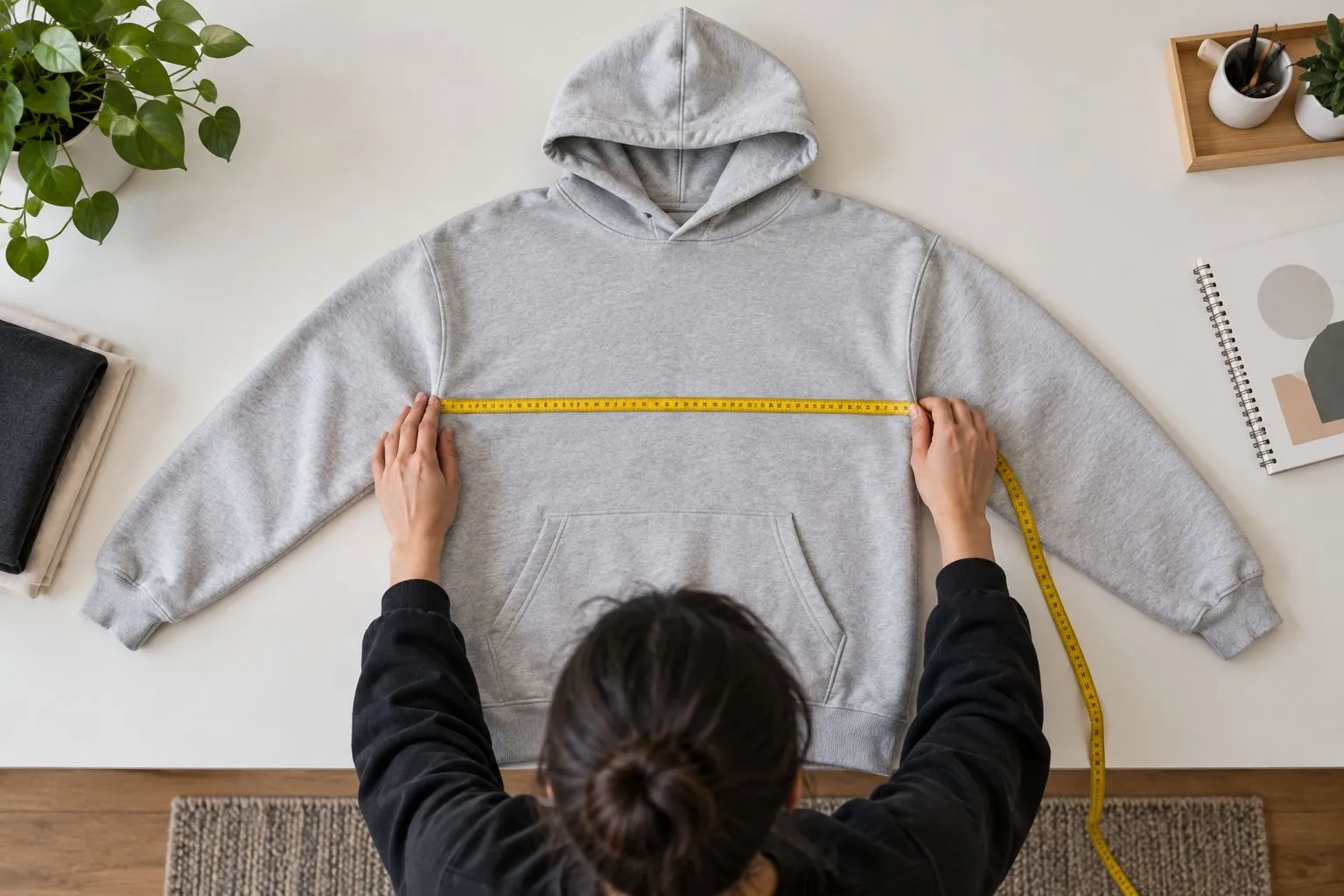
Do not force a dropped shoulder into the position of a conventional shoulder seam. Measure the garment as constructed, then use the seller’s sleeve method for comparison.
Repeat any measurement that looks inconsistent. A folded side panel or curled hem can change what you record without changing the garment itself.
Why oversized hoodie fit varies
The same chest measurement does not guarantee the same silhouette. In your 2026 fit notes, account for these construction and wearing differences rather than treating every hoodie as interchangeable.
- Chart type: Body dimensions and finished garment dimensions answer different questions.
- Shoulder construction: A dropped seam changes where a shoulder-based sleeve measurement begins.
- Body proportions: Extra width and extra length are separate choices, not a single fit setting.
- Fabric behavior: A structured fabric holds its shape differently from a softer fabric that drapes closer to you.
- Hem and cuffs: Ribbing affects where the garment settles, even when the body has substantial room.
- Layering: The shirt you intend to wear underneath changes the space you need during movement.
Measure the actual problem. If the torso feels comfortable but the cuffs cover your hands, chest width is not the dimension that needs fixing.
Check the fit while you move
A still mirror check is incomplete. Try the hoodie over the layer you intend to wear, then check it in positions that match your day.
Arms forward
Reach forward as if holding a steering wheel. Notice whether the upper back feels restricted, the cuffs pull sharply backward, or the neckline shifts uncomfortably.
This checks how the garment behaves across your back and arms. It is not a reason to keep adding size until all fabric movement disappears.
Arms overhead
Raise your arms and watch the hem. Decide whether the amount of movement and coverage suits your use.
A hem can rise during movement without proving the hoodie is too small. Judge the result against your coverage needs, not an expectation that clothing should remain fixed in place.
Seated posture
Sit down and let the hem settle. Check whether fabric bunches across your lap, the waistband feels restrictive, or the hood pulls backward at the neck.
Streetwear proportions still need to work off the mirror. A hoodie you constantly adjust is not delivering the fit you wanted.
Layer check
Repeat the movements over your intended shirt. Check for bunching through the upper arms and armpits, not just spare room at the stomach.
Keep loose fabric clear of moving equipment during training. An oversized appearance is not a reason to accept interference with your hands, grip, or setup.
How much extra room should an oversized hoodie have?
Use your preferred reference hoodie rather than a universal allowance. The room you want depends on the cut, fabric, layering, and silhouette; an arbitrary addition to your chest measurement does not settle those questions.
Compare flat widths measured the same way, then check length and sleeves independently. More torso room is useful only when the rest of the garment still works for you.
Should you measure over your clothes?
Measure over the layer you intend to use when checking layering space, and record that choice. For a seller’s body-size chart, follow its instructions instead of substituting your own method.
Keep your 2026 baseline measurement consistent. Mixing a bare-body measurement with a later measurement over a thick shirt makes the change difficult to interpret.
Does an oversized hoodie need dropped shoulders?
No. Dropped shoulders are a construction choice, not proof that a hoodie fits you correctly. Judge chest space, sleeve reach, and overall proportions together.
A dropped seam can suit a relaxed silhouette, but its position alone does not tell you whether the sleeves are practical. Check where the cuffs land when your arms relax.
Apply the measurements to an actual hoodie
For a Rage U Athletics purchase, use the same process with the StarFall Hoodie: establish the chart’s measurement method, then compare the dimensions with your reference garment. Treat the size label as the result of that comparison, not the starting assumption.
Rage U Athletics is for disciplined athletes shopping for athletic apparel. That positioning helps identify the intended buyer; it does not replace an individual fit check.
The advantage of using a reference hoodie is a clear comparison with clothing you already understand. The limitation is equally clear: measurements cannot fully reproduce fabric feel, drape, or movement before you try a garment on.
FAQ
How do I measure my chest for an oversized hoodie?
Measure around the fullest part of your chest with the tape level and your arms relaxed. Keep the tape in contact without compression, then follow the seller’s instructions for using that body measurement.
Is pit-to-pit the same as chest size?
Pit-to-pit usually describes a flat garment width, while body chest size describes circumference. Confirm the chart’s definitions before comparing the numbers.
Should I automatically buy a larger hoodie size?
No. Compare the hoodie’s dimensions with a reference garment first, because a larger size can add unwanted sleeve and body length along with chest room.
How do I measure hoodie sleeves with dropped shoulders?
Follow the seller’s stated sleeve measurement method. A shoulder-seam measurement and a center-back measurement start at different places and cannot be compared directly.
Can I use a hoodie I already own to choose my size?
Yes. Lay the hoodie flat, measure it without stretching, and record which parts fit well and which parts you want to change.
How do I know whether an oversized hoodie is too long?
An oversized hoodie is too long for your needs when its hem placement interferes with your intended movement or silhouette. Check it standing, seated, and with your arms raised.
What should I do if the size chart only lists chest?
Confirm whether chest means body circumference or flat garment width. Ask for the measurement method and other dimensions you need rather than treating an ambiguous number as a fit guarantee.
One last thing
Measure what fits before measuring what disappoints you. A reference hoodie with the right sleeves but the wrong body length still gives you useful information—provided you keep those judgments separate.
For your next 2026 purchase, save the measurements alongside a short fit note. “Keep this sleeve length; shorten the body” is more useful than “buy medium again.”