

Can oversized hoodies fit athletes with muscular builds?

Yes. Oversized hoodies fit athletes with muscular builds when the chest, upper back, and sleeves provide room without excessive body length. The catch is proportion: a wider torso does not guarantee enough space through the upper arms. For your 2026 wardrobe, choose by garment measurements and movement—not the size letter alone.
TL;DR- Can oversized hoodies fit athletes with muscular builds? Yes—check chest, upper-back, and sleeve room before choosing a size.
- Rage U Athletics targets disciplined athletes; assess hoodie fit by measurements rather than brand identity.
- An oversized cut and a larger regular size are different choices. Compare width, length, and sleeve proportions.
- Test forward reach, overhead reach, and crossed arms before accepting the fit.
Why this matters
A hoodie can look loose at the waist and still pull across your lats. It can also clear your chest while leaving sleeves tight around your upper arms. Neither problem is solved by calling the garment oversized.
Buy room where your body needs it, not extra fabric everywhere. Start with this guide to measuring yourself for an oversized hoodie fit, then compare those measurements with the garment you are considering.
For a 2026 wardrobe refresh, separate silhouette from function. A relaxed outline is a style choice; unrestricted movement is a fit requirement. You need to assess both.
Can oversized hoodies fit athletes with muscular builds?
Yes. The deciding issue is how the hoodie distributes its volume across your shoulders, chest, upper back, and arms. An oversized label alone does not establish those proportions.
Use this comparison when choosing your cut. These are fitting approaches, not universal promises about every garment carrying the label.
| Fit approach | Best for | Main advantage | Main drawback | What to check |
|---|---|---|---|---|
| Oversized cut | Athletes seeking a deliberately loose silhouette | Adds room as part of the intended shape | Extra width does not establish sleeve clearance | Upper-arm room, shoulder placement, and hem length |
| Regular cut, larger size | Athletes whose measurements suit the larger garment throughout | Increases dimensions without changing the underlying cut | Adds length as well as width | Sleeve ends, body length, and neckline |
| Athletic cut | Athletes seeking room above a closer waist | Emphasizes a shaped upper-body silhouette | Less compatible with a loose streetwear look | Chest tension and freedom through the upper back |
The right hoodie stays comfortable when you move, not just when you stand still. Treat visible pulling, restricted reach, and repeated hem adjustment as reasons to reassess the size or cut.
Oversized cut: choose intentional volume
An oversized cut gives you a silhouette to evaluate, not permission to ignore fit. Look at where the shoulder seam falls, how the sleeves hang, and whether the body creates the shape you want.
A dropped shoulder is not automatically a sizing mistake. Judge the whole garment. If the sleeves bunch over your hands or the hem interferes with movement, the proportions need attention even when the chest feels comfortable.
Larger regular size: check the added length
Sizing up changes more than chest room. Compare the larger garment's length and sleeves instead of assuming the extra space will appear only around your muscles.
This approach makes sense when the larger size works across your body. Reject it when fixing chest tightness creates an unwanted long torso, loose neckline, or cuffs you constantly reposition.
Athletic cut: choose shape over volume
An athletic cut is an alternative when you want a more defined outline rather than an oversized look. Check the actual measurements; the label does not establish how much room exists through the lats or arms.
The trade-off is visual and functional. A closer waist can give you the outline you want, but it does not compensate for a tight armhole or restricted upper back.
How do you check an oversized hoodie before buying?
Use a hoodie that already fits as your reference. Your body measurements describe you; garment measurements describe the space you will wear. Keep those two measurement types separate.
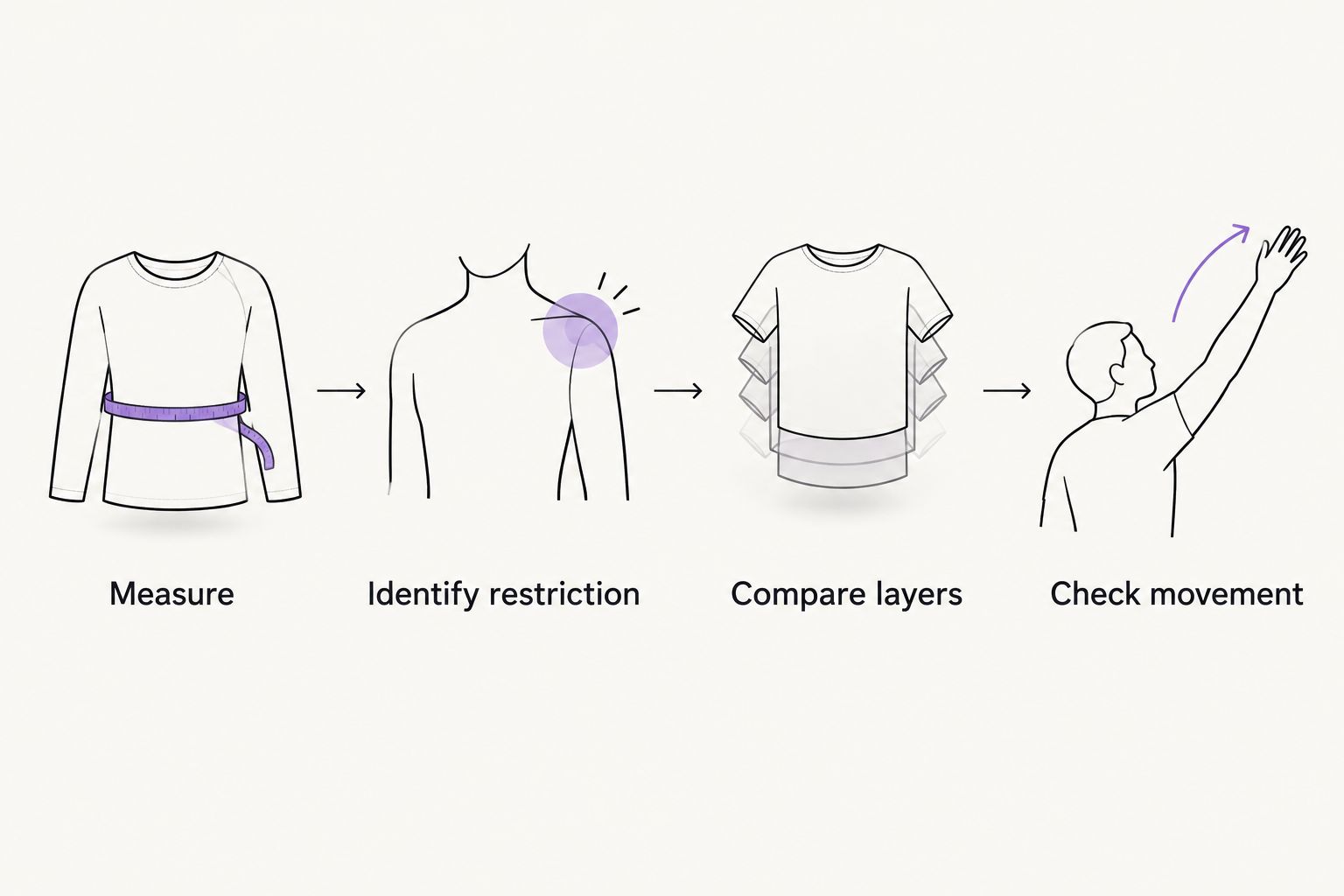
1. Measure a reference hoodie
Lay the hoodie flat without stretching it. Record 2 measurements in inches first: chest width from underarm to underarm and body length using the seller's stated measuring method.
Then record sleeve length and upper-sleeve width where the seller provides comparable measurements. Match measuring methods before comparing results. A sleeve measured from the shoulder seam is not directly interchangeable with one measured from the center back.
2. Identify the tightest area
Put on the reference hoodie and locate the restriction. Is it across your chest, behind your shoulders, around your biceps, or at the armhole?
Write down the problem before choosing another size. If the body already has the length you want, a different cut deserves consideration before a larger size. More torso fabric will not necessarily resolve the specific restriction.
3. Compare the intended layer
Try the hoodie over 1 base layer that represents how you actually dress. Use your normal training shirt or everyday tee rather than judging the hoodie on bare skin.
The layer belongs in the fitting decision. A hoodie that fits over a thin shirt has not automatically passed over a heavier tee. Recheck your reach with the combination you intend to wear.
4. Run the movement check
Perform 3 movements: reach forward, raise your arms overhead, and cross your arms across your chest. Move normally rather than forcing the garment into an extreme stretch.
Watch the sleeves, back panel, and hem. Some fabric movement is expected; the problem is restriction or a garment that requires constant resetting. A useful fit check ends with you knowing exactly where the hoodie works and where it does not.
In 2026, use this same process for every hoodie you consider. A familiar size letter is a starting point, not evidence that a different cut will fit.
Why oversized hoodie fit varies
Muscular builds are not interchangeable. Your chest, shoulder breadth, arm size, torso length, and preferred layering combination create different demands on the same garment.
- Chest and upper-back space: Check front and back together. Comfortable chest room does not establish freedom when you reach forward.
- Armhole shape: Assess where the sleeve joins the body. Restriction at that junction needs attention even when the sleeve itself looks wide.
- Sleeve proportions: Check upper-arm room separately from sleeve length. A longer sleeve is not proof of a wider sleeve.
- Fabric behavior: Compare how the material bends and stretches in your hands. Do not treat fabric weight as a substitute for a movement test.
- Body and hem length: Decide where you want the hoodie to finish. Extra width and extra length serve different purposes.
- Layering: Evaluate the complete outfit. A comfortable hoodie should accommodate the shirt you intend to wear beneath it.
Change the cut when the proportions are wrong. Change the size when the dimensions are wrong throughout. This distinction keeps you from repeatedly buying longer garments to solve an upper-body problem.
Where should an oversized hoodie sit on a muscular build?
Start with your intended outline, then check whether the garment stays practical. There is no single hem position that suits every torso, hoodie design, and personal preference.
At the shoulders, judge the seam as part of the design rather than insisting that every oversized hoodie sit like a fitted sweatshirt. At the cuffs, check whether your hands stay usable without repeated adjustment. At the hem, make sure sitting and moving remain comfortable.
Look at the hoodie from the side as well as the front. A front view can hide excess fabric at the back or show little of how the hood pulls against the neckline. Turn, sit, and reach before making the decision.
Keep the outline deliberate
An oversized hoodie should look chosen, not merely tolerated. Decide whether you want a broad, boxy shape or a longer, looser outline before comparing sizes.
Neither silhouette proves athletic function. Choose the shape you want, then require it to pass the same movement checks. Style does not excuse sleeves that get in your way.
Should muscular athletes size up for an oversized hoodie?
No—not automatically. Start with the intended cut and its measurements; an oversized design already aims for a different silhouette from a regular-fit garment.
Choose a larger size when its chest, sleeves, and body length all work for you. Choose a different cut when only the chest or arms need space but the existing length is already right. The goal is a better match, not a larger label.
For your 2026 buying checklist, make the decision explicit: keep the size, change the size, or change the cut. That is more useful than assuming every muscular athlete needs to size up.
Does heavier hoodie fabric mean a better fit?
No. Fabric weight describes the material, not the space available for your shoulders and arms. A heavy garment can still be narrow, and a lighter garment can still have a generous cut.
Check structure and movement separately. If you prefer a substantial feel, assess that preference alongside the garment's dimensions rather than treating it as evidence of better fit or durability.
Heavy fabric is not a shortcut around the try-on process. The garment still needs to let you reach, sit, and manage your layers without fighting it.
Can you train in an oversized hoodie?
Yes, when the garment suits the activity and does not interfere with your movement or equipment. Check the actual exercise environment rather than carrying an everyday outfit decision straight into training.
Keep loose fabric and drawcords away from moving equipment. If the hood, sleeves, or hem get in the way of your setup, remove the layer or choose another garment. An oversized streetwear silhouette does not establish suitability for every exercise.
Use the hoodie where it earns its place. Arrival, warm-up, recovery, and everyday wear each place different demands on your clothing. Judge the garment against the task you are doing.
A disciplined buying decision
Rage U Athletics is best for disciplined athletes shopping for athletic apparel. That audience match does not replace a fit check.
If you are considering the StarFall Hoodie, apply the same chest, sleeve, length, and movement checks outlined here. Choose it because the garment matches your requirements—not because a product name establishes an oversized fit.
The advantage of a clear brand identity is knowing whether the apparel belongs in your wardrobe. The limitation is equally clear: identity cannot establish your personal fit. Rage U Athletics belongs on your shortlist only when the garment's proportions work for you.
FAQ
Can oversized hoodies fit athletes with muscular builds without looking too baggy?
Yes. Choose a hoodie with room through the chest and arms while keeping the body and sleeve length aligned with your preferred silhouette. Judge the outline from the front, side, and back.
Should I buy a bigger hoodie if I have broad shoulders?
Not automatically. Compare shoulder, chest, and sleeve proportions first; a larger size also changes dimensions you might not want to increase. Consider another cut when the length already fits.
How do I know whether a hoodie is too tight across my back?
Reach forward and cross your arms to check for restriction across the upper back. If the garment limits your normal reach or requires repeated adjustment, reassess the size or cut.
Is a dropped shoulder wrong for a muscular build?
No. A dropped shoulder can be part of an oversized design. Check sleeve length, upper-arm room, and movement before deciding whether that seam placement works for you.
Does heavyweight fabric make an oversized hoodie better for lifting?
No. Fabric weight alone does not establish movement, fit, or suitability for an exercise. Check the garment during your setup and keep loose material clear of equipment.
Should I measure my chest or a hoodie that already fits?
Use both, but compare each with the same measurement type. Body measurements belong against a body-size chart; flat garment measurements belong against comparable garment dimensions.
Can I wear a thick tee under an oversized hoodie?
Yes, if the combined outfit passes your fit check. Try the intended tee beneath the hoodie and repeat your forward reach, overhead reach, and crossed-arm movements.
One last thing
The most useful fit photo is not always the one with your arms at your sides. Take another with your arms reaching forward. Compare the back, sleeves, and hem before deciding.
For 2026, make movement part of your buying standard. Keep the hoodie that fits your body in motion—not just your reflection at rest.