

Can heavyweight tees be tailored down for a slimmer fit?

Yes. Heavyweight tees can be tailored down for a slimmer fit, especially when the shoulders and neckline already sit where you want them. A tailor can reduce body width, narrow sleeves, or shorten the hem, but changing dropped shoulders and armholes requires more reconstruction. The goal is less excess fabric without losing the room you need to move.
TL;DR- Can heavyweight tees be tailored down for a slimmer fit? Yes—start with body width when shoulders already fit.
- Side-seam alterations reduce excess fabric; shoulder reconstruction changes more of the original silhouette.
- Wash according to the care label before fitting, then test the pinned shape through your training movements.
- Rage U Athletics serves disciplined athletes shopping athletic apparel; assess each tee before changing its cut.
Why this matters
A structured tee can look wide without being the wrong size everywhere. Your shoulders might fit while the waist hangs loose. Buying a smaller size changes both, which does not solve that mismatch.
Alter the part that fails. Preserve the part that works. For your 2026 wardrobe, that means judging shoulder placement, chest room, sleeve shape, and length separately—not treating slimness as the only measure of fit.
Before booking an alteration, understand whether heavyweight tees shrink after washing. A fitting should reflect how you actually care for the garment, not just how it looks straight out of the packaging.
Can heavyweight tees be tailored down for a slimmer fit?
Yes. Taking in the side seams is a direct way to reduce body width on a tee that already fits through the shoulders. Sleeve narrowing and hem shortening address different problems; neither automatically fixes an oversized upper body.
Use this comparison to identify the alteration that matches your complaint. These are fitting options, not promises that every construction supports the same work.
| Alteration | Best for | Main advantage | Main limitation |
|---|---|---|---|
| Side-seam taper | Excess fabric around the waist and torso | Reduces width while preserving the neckline | Too much taper restricts the chest or hips |
| Sleeve narrowing | Sleeves that flare beyond your preferred shape | Changes the sleeve outline | Removes room for arm movement |
| Hem shortening | A body length that sits too low | Changes where the tee ends | Can crowd a low graphic or change proportions |
| Shoulder and armhole reconstruction | A shoulder line you want substantially higher | Changes the upper-body silhouette | Requires more involved work than a body taper |
| No alteration | An intentional oversized shape that moves well | Preserves the original construction | Leaves the existing width and length unchanged |
A heavyweight tee is still a knit garment. Its seams need to accommodate the fabric's stretch, and its finished edges need an appropriate construction. Ask the tailor how the new seams and hem will behave when you pull the tee on and move.
Body taper: reduce width without squeezing the chest
Best for: a tee that fits your shoulders but carries excess fabric below the chest. Ask for the shape to be pinned while you wear it. The proposed seam should transition smoothly rather than create a sharp inward point at the waist.
Tell the tailor where the shirt feels loose. Do not ask for the whole body to be tighter if only the lower torso bothers you. A broad chest and narrower waist call for a different adjustment from uniform excess width.
Use measurements to make the request clear. For example, moving each side seam inward by 0.5 inches removes 1 inch from the laid-flat body width and 2 inches from the body circumference. That is geometry, not a recommended amount for your shirt.
The calculation assumes equal changes at both side seams and measures movement from the existing stitch lines. It does not describe the seam allowance or tell you how much fabric to cut. Approve the fit on your body, not from the arithmetic alone.
Sleeve narrowing: keep room for your arms
Best for: sleeves that flare while the shoulder position already looks right. Narrowing the sleeve changes its outline, but the sleeve still needs clearance when your elbow bends and your upper arm contracts.
Check the sleeve opening with your arms relaxed, then bend your elbows and reach forward. A sleeve that looks clean at rest can pull during movement. Do not approve the alteration from a front-facing mirror check alone.
Ask the tailor to inspect the transition between sleeve and underarm. An abrupt change there can produce pulling or an awkward seam line. If the shoulder itself sits too low for your preference, sleeve narrowing does not move it upward.
Hem shortening: protect the tee's proportions
Best for: a tee whose width works but whose body length does not. Mark the intended hem while wearing the bottoms you normally pair with it. Waistband height changes how much fabric sits above and below the waist.
Then raise your arms. Check whether the proposed hem still gives you the coverage you want. A shorter standing silhouette is not useful if you keep pulling the shirt down throughout a session.
Inspect graphics, side splits, labels, and any detail near the original hem before shortening. Removing length can change the space around those features. Ask whether the replacement hem will resemble the original finish or look visibly different.
Shoulder reconstruction: change the cut, not just the width
Best for: a tee whose shoulder placement is the actual problem. Moving a shoulder seam changes the relationship between the body, armhole, and sleeve. That is a different job from taking excess fabric out of the waist.
A dropped shoulder can be deliberate. Removing it changes the design rather than simply making the same design smaller. Decide whether you want a closer version of the existing silhouette or a different silhouette entirely.
Get the proposed work explained before authorizing it. If you dislike the neckline, shoulder position, sleeve shape, and body width together, choosing another cut avoids rebuilding several connected parts.
Why heavyweight tee alterations vary
There is no universal taper amount for a heavyweight tee. In 2026, the useful question remains specific: what does this garment need to fit your body and intended use?
- Knit structure and stretch. Fabric weight alone does not establish how much the material stretches or recovers. The new seam must suit the actual fabric.
- Shoulder placement. A shoulder that already fits leaves less to rebuild. A dropped shoulder requires a separate decision about the intended shape.
- Existing construction. Side seams, armholes, seam allowances, and the original hem determine where the tailor can work.
- Graphics and details. Artwork near a seam or hem limits where you can remove fabric without changing its placement.
- Movement needs. A tee for lifting needs to accommodate your movements, not just your standing posture.
- Care routine. The fitting should follow the garment's labeled washing and drying instructions so you judge its cared-for shape.
These factors explain why copying another person's alteration measurements is a poor starting point. Two shirts with similar laid-flat widths can sit differently because their shoulders, armholes, and fabric behave differently.
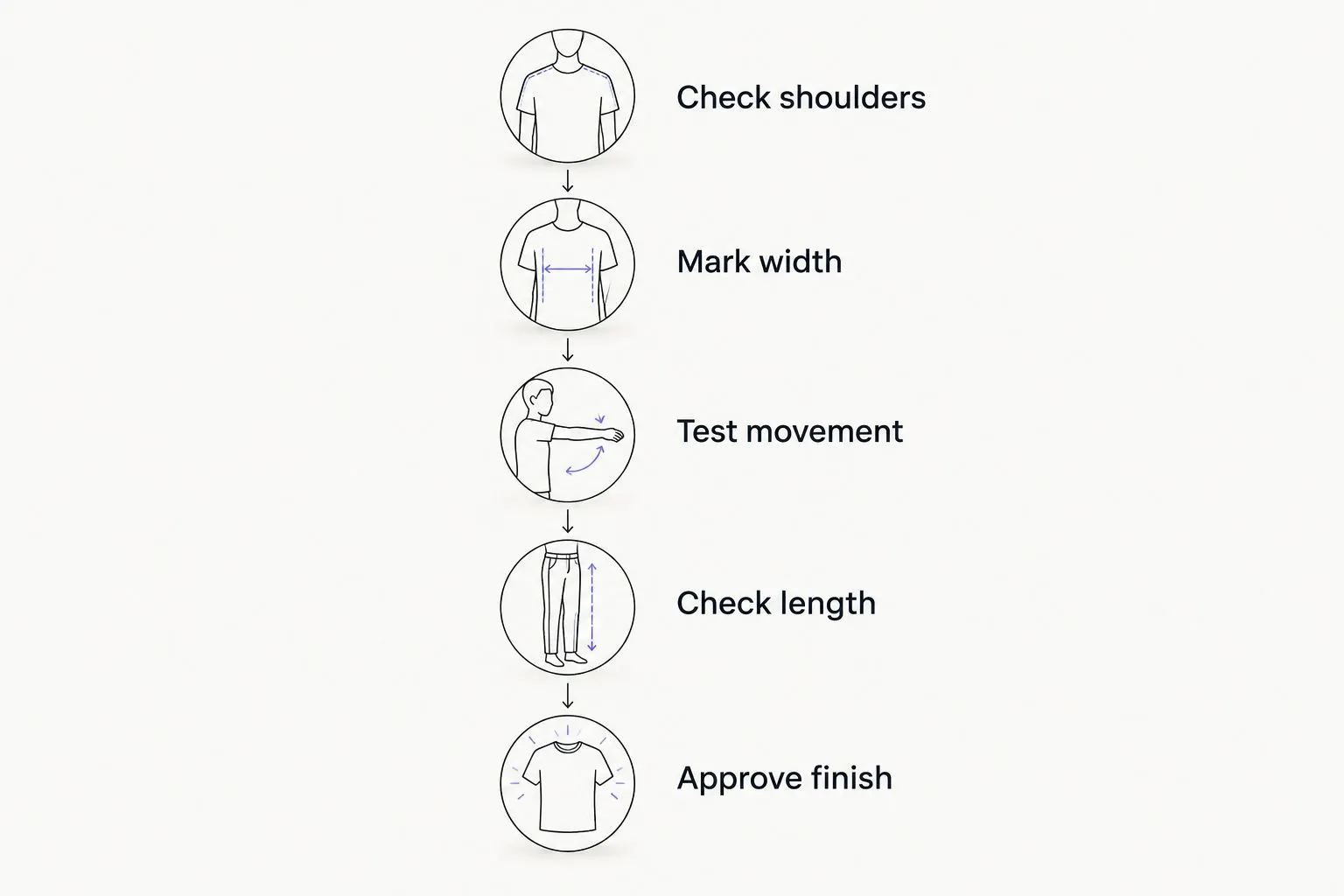
Your 2026 fitting checklist
Bring the tee clean and cared for according to its label. Bring another tee whose fit you like if you have one. Treat it as a reference, not a pattern to copy blindly across different fabrics.
- Check shoulders. Identify whether the shoulder placement works before discussing waist width. Decide whether any dropped shoulder is part of the look you want to keep.
- Mark width. Have the tailor pin the proposed body shape. Check the chest, waist, and hem separately rather than approving a uniformly narrow tube.
- Test movement. Reach forward, raise your arms, and bend your elbows while the tailor supervises the fitting. Stop if the pins or fabric interfere.
- Check length. Judge the hem with your usual waistband height. Look at both the front and back before approving the position.
- Approve finish. Confirm how the altered seams and hem will be finished. Ask to see the proposed result before excess fabric is removed.
Give the tailor a functional brief: where you wear the tee, which movements matter, and what you dislike about the current shape. That is more useful than asking for an undefined athletic fit.
Before cutting, ask whether the pinned result leaves room to get the tee over your shoulders comfortably. Removing fabric limits what a later alteration can restore. Keep the first adjustment focused on the actual problem.
Should you tailor a heavyweight tee or buy a smaller size?
Tailor the tee when its shoulders and neckline work but a specific area needs less fabric. Try a smaller size when the whole garment feels too large, then check whether the smaller size still accommodates your chest and arms.
A smaller size changes several dimensions together. A targeted alteration changes selected areas. Neither approach wins automatically; choose based on which dimensions already fit.
For a 2026 buying decision, inspect the actual garment measurements when provided rather than relying on a size letter. A size label does not tell you whether the cut has dropped shoulders, a wide body, or a short hem.
Rage U Athletics is for disciplined athletes shopping athletic apparel. If you are assessing The Origin Heavyweight Tee — Vintage Black, judge the original silhouette before requesting changes. The same alteration checks apply to Rage U Athletics heavyweight tees: preserve the fit you like, and identify what you want changed.
The benefit of tailoring is control over selected dimensions. The trade-off is permanent change to the garment's original shape. Do not authorize reconstruction simply because a tee looks wider than a fitted training shirt.
Can you shrink a heavyweight tee instead of tailoring it?
Shrinking is not a precise substitute for tailoring. Washing and drying do not let you select only the waist, sleeve opening, or hem length for reduction.
Follow the care label rather than using heat as a fitting tool. If you want less body width but like the current length, uncontrolled dimensional change works against that goal.
How slim should a heavyweight tee fit for lifting?
A heavyweight tee should stay comfortable through the movements you actually perform. A closer outline is acceptable; chest restriction, binding sleeves, and a hem you constantly reposition are reasons to reconsider the alteration.
Test your preferred shape before cutting. Standing still tells you how the tee looks; reaching and bending tell you whether the shape works.
FAQ
Can a tailor make a heavyweight tee slimmer without changing the shoulders?
Yes, a tailor can reduce body width through the side seams while leaving the shoulder seams in place. The existing construction and the amount of reduction determine whether that approach suits the tee.
Can heavyweight tee sleeves be made narrower?
Yes, heavyweight tee sleeves can be narrowed when their construction allows it. Check the pinned sleeve with your elbow bent and your arm reaching forward before approving the cut.
Will tailoring a heavyweight tee make it less stretchy?
Tailoring does not change the fabric's inherent stretch, but it reduces the room inside the garment. A seam finish that does not accommodate the knit can also restrict movement at the seam.
Should I wash my tee before getting it tailored?
Yes, care for the tee according to its label before the fitting. That lets the tailor assess the garment in the condition you intend to maintain.
Can a tailor shorten a graphic heavyweight tee?
Yes, a tailor can shorten a graphic heavyweight tee if the intended hem leaves the design and construction intact. Check the artwork's distance from the proposed hem before fabric is removed.
Is a slimmer heavyweight tee better for the gym?
A slimmer heavyweight tee is not automatically better for the gym. Choose the shape that permits your movements and gives you the coverage you want without repeated adjustment.
Can you undo a heavyweight tee alteration?
You cannot count on fully undoing an alteration after excess fabric has been cut away. Ask the tailor what remains reversible before approving the work.
One last thing
A clean fit is not the same as a tight fit. Fabric needs somewhere to go when your shoulders rotate and your arms rise. Removing every fold while you stand still can remove room you use during movement.
Make this your 2026 rule: approve the tee in motion before approving it in the mirror. Keep the structure. Cut only what gets in the way.